Formal assurance under uncertainty
Connect verification to model revision and runtime monitoring, so changes in the evidence trigger a reconsideration of the properties a system can support.
My research focuses on trustworthy AI: privacy in collaborative learning, safety and security in human-centered systems, and reliable decisions under uncertainty. Bayesian inference connects these questions across distributed learning, multi-agent systems, and mixed reality.
I connect probabilistic learning with questions about the consequences of an AI system’s decisions. That means examining what information a model shares, how its confidence is justified, and what evidence supports a safety claim.
My work spans theoretical methods, experiments with distributed sensing, and models of human state. Across these settings, I aim to make uncertainty and the assumptions behind a decision explicit.
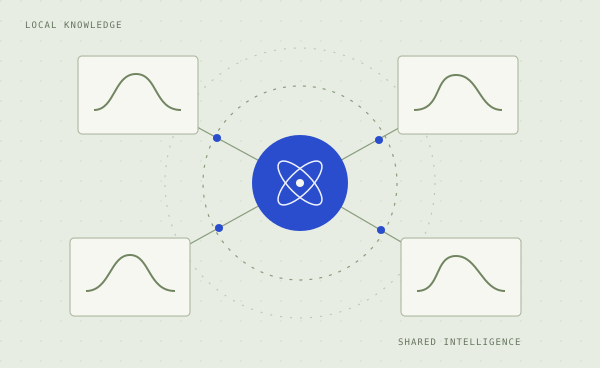
Different clients see different data. I study how Bayesian inference can model those differences, organize clients into useful groups, and combine local knowledge without overlooking dependencies between models.
In my clustered federated learning work, I formulate client–cluster association as an inference problem and develop approximations that make multiple association hypotheses tractable. Related work studies personalized jamming classifiers and communication-efficient learning across sensing devices.
These methods support collaboration without pooling raw observations. My broader privacy agenda asks what shared statistics and model updates reveal, and how explicit information protection changes personalization and uncertainty.
Immersive systems can affect attention, performance, and physical comfort. I develop probabilistic models of human state and methods for checking safety properties relative to a model and its evidence.
As modeling lead on a DARPA-funded project, I work on cognitive security in mixed reality, including cybersickness verification and robust engagement estimation under cognitive attack.
My ISMAR study connects system features, physiological responses, and cybersickness through a hierarchical Bayesian network. Encoding that model and specified risk properties in a probabilistic program makes it possible to check risk thresholds under observed or uncertain conditions.
This connects human-state prediction with formal probabilistic verification. The next question is how those assurances should change as users, observations, and operating conditions change.
When agents learn and act together, sharing information is only useful if they can account for what each agent already knows. I investigate posterior sharing, coordinated exploration, and decision-making under uncertainty.
My shared-prior data-fusion work analyzes what happens when local Bayesian models inherit common information. Treating those models as independent can count the same evidence repeatedly and distort the combined belief.
Our work on federated posterior sharing lets agents exchange probabilistic knowledge of an uncertain environment. It provides a foundation for studying how collaboration can improve decisions while preserving a clear account of the evidence behind them.
In my 2026 preprint on multi-robot active inference, I connect belief fusion with exploration: realized evidence increments update shared knowledge, while anticipated evidence helps robots account for teammates’ planned observations. Under the paper’s stated modeling assumptions, this addresses repeated information at fusion and redundant exploration at planning.
My long-term goal is human-centered AI that can personalize its behavior, withstand manipulation, and recognize when its assumptions no longer hold.
Connect verification to model revision and runtime monitoring, so changes in the evidence trigger a reconsideration of the properties a system can support.
Study attacks and legitimate user differences together, while developing explicit information protection for shared updates. User-level differential privacy is a future research direction within this agenda.
Study how systems should adapt to people over time, when they should request more evidence, and when a decision should return to a person.